Saturday, April 16, 2011

Early English set


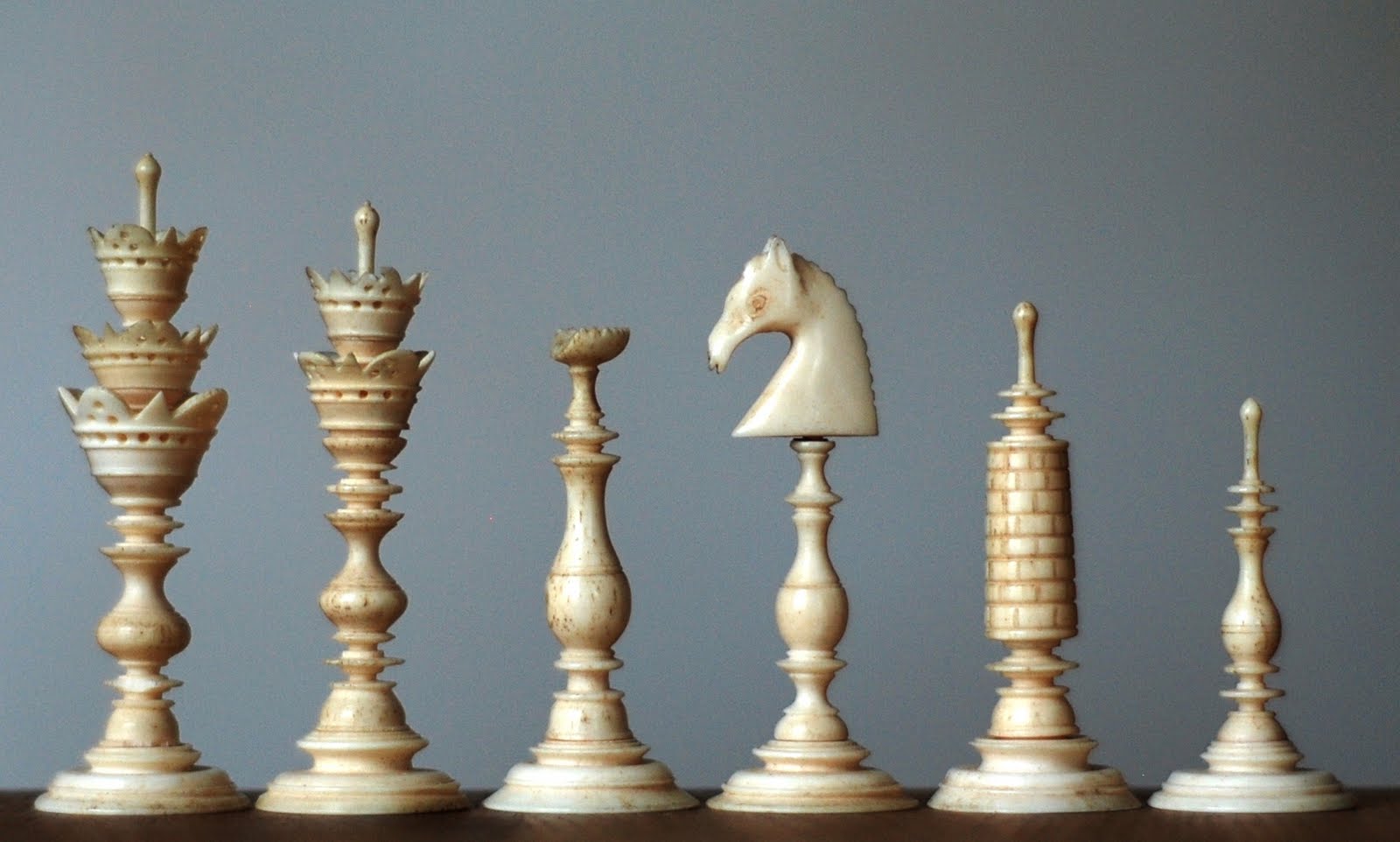
This bone set has several interesting features. It is unmistakably English and has all markers of 1700s which could be seen in Washington pattern as well: urn-like bases and necks + bent horse heads. All pieces besides Rooks are normal 18th C. English.

The rooks, however, are quite similar to the well known elaborate "Spanish pulpit" pattern which most probably has not anything to do with Spain. See examples of that pattern here, here and here. Besides Rooks, all these sets have common colour of the black side and the screw threads seem to be similarly manufactured as well. Researchers and collectors like Michael Mark and Hans & Barbara Holländer (see the famous exhibition catalogue) have long classified these sets as English but attribution to Spain still persists among some people. My set might be considered a further proof for the English origin.

The trouble with the Pulpit pattern is that there does not seem to exist two identical Pulpit sets and their number is rather low compared to the output of major chess set makers. It is still unknown if the same maker produced other sets and who he might have been. This set, for example, is rather similar to mine albeit Rooks.

All 32 pieces are present. There are some restorations (one Black Knight head is replaced and some crenellations repaired) which do not affect the overall impression. Rather contrary, some damage is expected if a chess set is more than 200 years old. The set has not been restained. Taking into account the original colour, screw threads etc., I am completely convinced that the Rooks are original to this set.

Saturday, April 24, 2010

Early Selenus pieces

A collection of Continental Selenus pattern pieces made of bone. It is not even a partial set, but all kinds are represented and the existing pieces are in good order. One can spot similarities with 18th C English Bird Nest pattern. The small-headed Knight looks also rather early. I think that the lot comes from the 18th century.

Friday, December 25, 2009

My first Italian set

A wooden chess set from the 18th century Italy.

Came with a box-board with drawer for wooden checkers. The board might come from the same period since the veneer is hand-sawn. The joints seem to be hand-made as well. It would be a definite marker of 18th century manufacture if it was British, but I am not so sure about Italy. The set itself is housed in a round container, which is most probably original.


Saturday, February 21, 2009

Bird Nest

An 18th-century ivory set from England. This small-cupped pattern is often called "Bird Nest" and looks like an English variation of Continental Selenus design.

The Knight head is pretty well worked for it's small size. It seems to have similarities with carvings of some French Knights from the same period.

Sunday, November 16, 2008

Danish variation of the Selenus pattern

An ultra-classic example of Danish Selenus pattern variation. These rather small but elegant and delicate bone sets are commonly dated to late 18th century.

Wednesday, November 5, 2008

Fine and interesting Selenus set

This set might be Danish but could in fact originate from Germany, Austria or Netherlands just as well. A somewhat similar but fancier set can be seen in "Schach Partie Durch Zeiten und Welten" page 222.

The same set photographed with flashlight.

Saturday, October 11, 2008

London

They constantly erect modern buildings next to grand and historical ones. The Tower of London looks like a puppet show decoration among the glass and concrete mountains.


Another example of this disgusting practice.


British humour?


Too bad that the 2-story buses are intended to be put out of use. They are fun to ride if you get a good place and great for sightseeing (and what a merry sight it is in the present case!)


Tourist items in 221B Baker Street (the Sherlock Holmes museum). One can see a horn Regence set often listed at eBay as vintage or antique among other brand new tourist chess sets. This one is interesting for two reasons. First, I did not have evidence that they are still producing them until today. Secondly, mind the White Knight with black base. Looks like something had gone wrong with either bleaching or staining process. They might make the both sides from one kind of horn after all, although the sets are usually listed as buffalo and cow horn. I do not know enough about that material to tell for sure but whatever the truth is, the piece on the picture does raise suspicions.

Mr. D. in action. The pictures are available at http://picasaweb.google.co.uk/chessspy/BonhamsChessCards141008


Great.

Medieval bone playing pieces and dice exhibited in the Tower of London.


A gorgeous rock crystal chess piece from the 11th century exhibited in the Tower of London.

Thursday, July 31, 2008

Fine Regence set with glass eyes

A good example of Regence sets with glass-eyed Knights. The set features prominent and well carved Knights with 19th C style glass inlay eyes (all of which are present) and finely turned other pieces. Pawns are of early design and the whole set should date to early 19th Century.

White side


Black side


A closeup of White major pieces

White Knight

Friday, June 6, 2008

Early "Encyclopedia" Regence set

A rare excample of an early Regence subpattern turned on so-called "rose lathe engine". The subpattern owes its name to the famous 1780 French encyclopedia compiled Diderot and d'Alembert where it illustrates the article about chess. It is still unclear when they started to make sets like that but obviously it had to be widespread and common to reach encyclopedia. The technology was available from the 16th century but it is hard to believe that the same design could have been produced for 200 years (compare the pattern of 1780 to the Regence set made in 1980). If the triangular Knights represent tricorne hats then it cannot be earlier than mid-1600s when seamen started to use them. Many people think that the triangular finials have nothing to do with these hats, though. A safe guess should be 18th century, possibly earlier.

A good explanation about the rose engine can be found here.

The set is made of boxwood and stained with tobacco which was the most common way in these days. Much of the stain is faded.

Illustration from the Encyclopedia.

A closeup view.

Closer still.

An interesting question about these sets is, which piece is Knight and which Bishop. Weirdly enough, it is far from certain.

The illustration above lines the pieces up in the order which we all are accustomed with. But the legend page from the same book tells us otherwise:

According to this, the pieces with tricorne finials are Bishops (Fou), not Knights.

However, if a Regence set has figural Knights, then Bishops look like Knights from an Encyclopedia set. Have a look at following pictures:

A picture from Hocquart's Traite d'Échecs (1810)
Note that the pieces are presented in the same order as in Diderot's encyclopedia. Queen, Bishops and Pawns have identical finials (small balls).

Another rose-engine set, picture from Offenbach 2005 Teil I ~ Die Ausstellung ~ Schach - ein Spiel der Vernunft in Offenbach am Main, Im Haus der Stadtgeschichte vom 19. März - 8. Mai 2005, ISBN 3-00-015869-3, page 27. Knights and Bishops look exactly how we are used to see them. Thanks to Alan Dewey and Joost van Reij for the reference and picture editing.

Many sets from the late 18th century or 19th century feature Bishops with small ball finials like Queens but having triangular collars and Knights with horse heads.

As my set looks exactly like in the encyclopedia of Diderot and d'Alembert, the pieces with triangular finials are most probably Bishops, not Knights and the photographs above show wrong setup. However, other early Regence subpatterns have Bishops similar to the Knights of my set.

Bishops with tricorne finials can also be found in early Spanish sets: see examples from Crumiller collection and Rocheford collection. The same is true about Italian sets (Witticke collection).

Saturday, May 17, 2008

Fine Kholmogory walrus ivory knight

This fine piece comes from a 18th century Russian Kholmogory set and is made of walrus ivory. The carving quality is second to none.

Walrus ivory

Sunday, May 4, 2008

Regence set


Finely turned and early Regence pattern chess set from around 1800. I have come to believe that it rather comes from the 1700s, though.


White pieces


Black pieces

Monday, January 21, 2008

Some words on small German sets

Small German sets and rollup boards were imported to England in remarkable diversity. Sometimes the sets carry the labels of English retailers, but they still come from Germany (an example from Crumiller collection).


The lid of the larger box has words "CHESS AND DRAUGHTS BOARD".


The larger set seems to be definitely German. It is known that roll-up boards were imported to England in the 19th century.


However, it seems to be that the smaller, truly miniature set follows exactly the same pattern. Only Knight heads are different. The sawed-out Knight heads similar to the miniature example above are often recognized as German.

Update July 14 2009: The common knowledge that these Knights are German is solidly based upon German pattern books. For example, this page from the Nuremberg manufacturers H. Heerdegen and C. Gottlieb dates from around 1870. The designs are fancier than my sets but the common attributes are easy to see. Many thanks to Jan for the information.


Another look at the major pieces with very similar fnials.


Both Rooks feature raised finials with concentric rings and rather wide bases.


The Rooks of the miniature set have bases which screw off. This is unusual.


Straw work on the lid of the smaller box. Although lots of straw work was done by the Napoleonic POWs, it was widely used in many European countries from the mid-1700s to late 1800s. The assumption that all straw work should be associated with Napoleonic POWs is not correct.

The similarities of the pieces suggest that both are German and come from the 19th century. While urn-shaped stems of English sets indicate early manufacture, it is not necessarily true about German sets. Many design elements continued to exist in Germany long after they were discarded in Great Britain. These include open cups (Selenus design runs well into the 20th century while the last English sets resembling open cup are the so-called Calvert or fountain sets from the 1st half of the 19th C) and urn-shaped stems.


A 19th century German or Dutch set, possibly Nuremberg, featuring urn-like stems, collars similar to Selenus design, Barleycorn-like barrels and sawed Knights (not from my collection).

Update July 30 2008: CCI newsletter "The Chess Collector" (4-5/1 Jan 1990) features an article about German sets by Franz Josef Lang. The author points out that the mid-1800s pattern book of Nurenburg turner A. Kolb has labels "American", "German" and "Roman" under the designs ("American" designs have mitred bishops common in Anglo-Saxon sets) and assumes that these indicate the target markets for these designs.

Update 2010: Please note that none of the sets above do not belong to my collection any more. The article was left up for discussion on the German sets.